Introduction
The quality of a first sales meeting no longer depends only on an Account Executive's selling skills.
Today, it depends just as much on preparation.
For years, preparing for a discovery call meant opening your CRM, LinkedIn, Google, the company website, Sales Navigator, battlecards, SDR notes, and previous emails — and spending 15 to 30 minutes piecing together everything you needed before the meeting.
Then Generative AI arrived. Today, many sales teams believe that ChatGPT or Claude have solved meeting preparation.
They haven't.
Large Language Models are excellent at summarizing information. But great meeting preparation isn't about generating summaries — it's about turning information into better conversations. That means arriving already knowing the prospect's business, their likely priorities, their current software stack, your competitors already in place, the best customer references to mention, the right discovery questions, and the likely objections.
That's what separates average discovery calls from meetings that consistently generate executive next steps.
In a nutshell
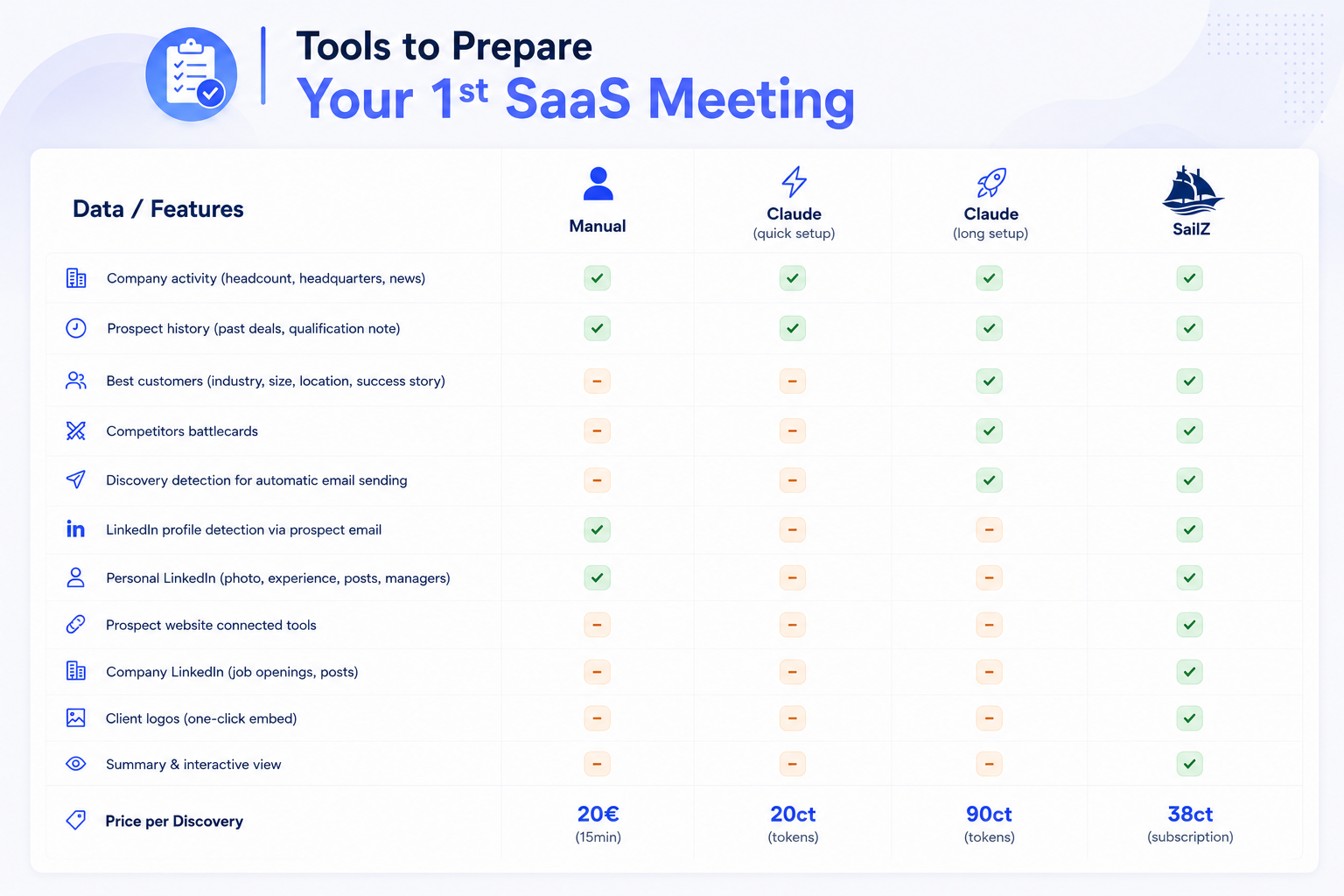
Today, there are four main ways to prepare for a SaaS discovery meeting.
- Manual preparation — Highest quality, highest personalization, extremely time consuming
- Claude or ChatGPT (basic setup) — Extremely fast, generic summaries, limited available data
- Claude connected to your CRM — Better personalization, more context, complex implementation, still limited by available data sources
- AI Meeting Prep software such as SailZ — CRM + public data + proprietary enrichment, interactive workflow, actionable insights, minutes instead of hours
Preparing for sales meetings is no longer an administrative task. It's becoming a competitive advantage.
Why meeting preparation has become a competitive advantage
Imagine two Account Executives selling exactly the same product — identical pricing, features, and customer references. Yet one consistently books executive follow-up meetings while the other struggles to move deals forward.
The difference usually appears during the first ten minutes. One AE asks: "I noticed your parent company is preparing for international expansion. How is that impacting your reporting processes?" The other asks: "Can you tell me a little about your company?"
Both are discovery questions. Only one demonstrates preparation. Prospects notice that difference immediately.
The four ways to prepare for a SaaS sales meeting
1. Manual research
This remains the gold standard in terms of depth. Most experienced Account Executives manually review CRM history, LinkedIn, company website, news, job postings, Sales Navigator, previous opportunities, and battlecards.
Advantages: maximum personalization, full control, deep understanding.
Drawbacks: 15–30 minutes per meeting, information scattered across multiple tools, difficult to scale. For organizations running hundreds of discovery meetings every month, manual preparation quickly becomes expensive.
2. Using ChatGPT or Claude with a simple prompt
This has become the most common approach. Sales reps paste CRM notes, website URLs, and LinkedIn profiles, then ask: "Prepare me for tomorrow's discovery call." The output is usually a company summary, industry overview, recent news, and suggested questions.
Advantages: very fast, extremely inexpensive, easy to use.
Limitations: a standalone LLM does not know your CRM history, internal customer references, competitor battlecards, previous lost deals, your sales methodology, or your customer migration stories. The result is usually an intelligent summary — but not true meeting preparation.
3. Connecting Claude to your CRM
Many organizations now connect Claude using APIs or MCP servers. Claude can now understand previous meetings, CRM notes, qualification history, and sales emails. The preparation becomes much richer.
However, even with CRM connectivity, AI usually cannot automatically access prospect LinkedIn activity, LinkedIn posts, technology stack detection, customer reference matching, competitor battlecards, downloadable logos, or interactive workflows. The output remains a document — not a sales workspace.
4. AI Meeting Prep platforms
Specialized platforms combine proprietary data, CRM enrichment, AI agents, automation, and sales workflows. The objective isn't to generate text — it's to help Account Executives sell better.
The information that actually wins deals
1. Company overview
Before every meeting you should understand employee count, revenue, products, customers, parent company, and recent news. This context improves every discovery question you ask.
2. CRM history
Probably the single most valuable source — it tells you previous conversations, objections, qualification notes, MEDDICC information, and previous opportunities. Nothing destroys credibility faster than asking a question your prospect already answered three months ago.
3. Customer references
Most sales teams still use "Our biggest customer." The best Account Executives use sister companies, competitors, local customers, and similar-size companies. Relevant social proof consistently outperforms famous logos.
4. Competitive battlecards
A useful battlecard should answer: Why would a prospect choose this competitor? Why have customers switched away from them? When are we genuinely stronger? Without those answers, battlecards become marketing documents instead of sales tools.
5. Technology stack detection
Knowing your prospect's existing software helps you identify competitors, adapt demonstrations, anticipate integrations, and prepare migration stories. Most LLMs cannot discover this information on their own.
6. LinkedIn profile
A prospect's LinkedIn profile reveals tenure, career progression, previous employers, responsibilities, and internal influence — context that helps personalize discovery from the very first minute.
7. LinkedIn activity
Posts and comments often reveal current initiatives, priorities, interests, and company culture. They also generate excellent icebreakers.
8. Job postings
Job descriptions expose software already used, hiring priorities, organizational challenges, department goals, and internal terminology. In many cases, half of your discovery call is already publicly available.
Why AI summaries are no longer enough
The problem is no longer information access. But after reading a two-page summary — what should the salesperson actually do?
Real meeting preparation requires action. Your workspace should let you open the relevant battlecard, view competitor intelligence, insert customer logos into slides, launch the LinkedIn profile, review CRM history, prepare discovery emails, and access relevant customer stories.
The future isn't better summaries. The future is actionable intelligence.
What's the real cost of meeting preparation?
- Manual research: ≈15 minutes — ≈$20 worth of AE time
- Basic Claude: ≈$0.20 — limited data
- Advanced Claude: ≈$0.90 — more context, long implementation
- SailZ: ≈$0.38 — rich proprietary data, interactive workflow, minimal setup
Why we built SailZ
Like most sales teams, we initially relied on Google, LinkedIn, CRM, ChatGPT, and Claude. The summaries became better. But sales performance didn't improve nearly as much.
The bottleneck wasn't AI — it was workflow. Salespeople needed the right data, at the right moment, inside the right interface, connected to real actions. That's why we built SailZ — the first AI Meeting Prep platform designed specifically for SaaS Account Executives.
What SailZ delivers before every first meeting
Within minutes of setup, every Account Executive automatically receives: CRM summary, company research, LinkedIn profile summary, recent company news, technology stack detection, competitor identification, customer references, battlecards, one-click customer logo insertion, and an interactive meeting workspace.
Instead of reading pages of AI-generated text — reps immediately know what to do.
FAQ
How do you prepare for a SaaS discovery call?
The best preparation combines CRM history, company research, LinkedIn insights, technology stack detection, customer references, recent news, and competitor intelligence before the meeting begins.
Is ChatGPT enough for sales meeting preparation?
ChatGPT is excellent at summarizing information, but it typically lacks access to CRM history, customer references, battlecards, competitor intelligence, and internal sales knowledge.
Is Claude better than ChatGPT for meeting preparation?
Both models provide excellent reasoning capabilities. The biggest difference comes from the quality of the connected data and the workflows built around the AI — not the language model itself.
How long should meeting preparation take?
Traditional preparation usually takes between 15 and 30 minutes. AI Meeting Prep platforms reduce that to just a few minutes while providing richer context.
What information matters most before a discovery call?
The highest-impact insights include: CRM history, company news, LinkedIn profile, technology stack, existing competitors, customer references, and buying committee structure.
Can AI replace meeting preparation?
No. AI accelerates research. Great salespeople still transform insights into meaningful conversations.
Conclusion
In 2026, information is no longer the competitive advantage. Everyone has Google. Everyone has ChatGPT. Everyone has Claude.
The real advantage belongs to sales teams that turn information into action before every meeting. Top-performing Account Executives don't necessarily prepare longer — they prepare smarter. And that's exactly what modern AI Meeting Prep is designed to enable.
Try SailZ
Discover how AI Meeting Prep helps SaaS sales teams increase executive next-step conversion rates through richer preparation, better discovery, and actionable insights.
Try SailZ